Classification of International Protection marking (IP) and Safety Integrity Level (SIL)
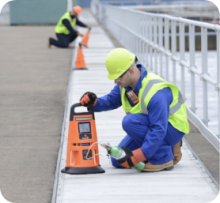
Gas detection equipment is often used in harsh environments: water jets, dust, and so on.
For this reason, there are a number of classifications that can be used to quickly identify the degree of protection afforded by a box :
- International Protection marking, known as the IP code, is an international standard of the International Electrotechnical Commission, first published in 1989. It is used in European standard EN605292. This index classifies the level of protection offered by a device against the intrusion of solid objects and liquids.
- Safety Integrity Level (SIL) is defined as a relative level of risk reduction inherent in a safety function, or as the specification of a risk reduction target. More simply, it is a measure of the performance expected of a safety function (or SIF).

Classification of International Protection marking (IP code)
The use of coded classifications to indicate the degree of protection of enclosures against infiltration and solid materials is now widespread. These classifications also cover the protection of personnel in the event of contact with live or moving parts within the enclosure.
The notation used to indicate waterproof protection consists of the letters IP followed by two numbers indicating the degree of protection :
- The first number indicates the degree of personal protection in the event of contact with live or moving parts in the enclosure.
- The second number indicates the degree of protection against infiltration.
For example:
- An enclosure classified as IP65 offers full protection of energized parts and parts in motion against ingress of dust or water.
- An enclosure classified as IP67 indicates that the equipment is protected against dust and the effects produced by immersion.
Note: this type of classification is suitable for gas detection equipment, such as control units, but the cooling of the electronic system needs to be monitored.
IP codes (IEC/EN 60529)

SIL classification for safety integrity levels
SIL stands for Safety Integrity Level and has 4 levels. The higher the SIL level, the lower the probability of failure on demand (PFD). Many gas and fire detection products were designed before SIL levels were introduced, and it is therefore possible for them to achieve a low SIL level, or even none at all, in individual assessments. Various techniques can be used to circumvent this problem, including more frequent testing or combining systems with different technologies (thereby eliminating common failure modes) to increase the SIL rating obtained.
For a safety system to achieve a particular SIL level, the sum of the probabilities of failure on demand (PFD) must be taken into account.

For example, for SIL2: PFD (sensor) + PFD (resolver) + PFD (trigger) < 1x10⁻²
The choice of the SIL level required for the installation must be made taking into account the level of safety management in the process itself. E/E/PES systems should not be considered as the primary safety system. Whatever the industrial process, design, operation and maintenance are the most important parameters in terms of safety.
Discover our gas detection ranges
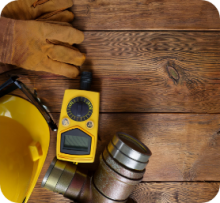
Portable Gas detector
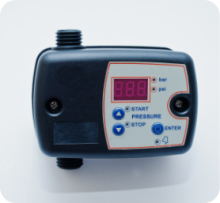
Fixed Gas Detector